
Why I’m Done Talking About “Resilience”
(And Why You Should Be, Too)
If you’ve worked in supply chain for more than five minutes, you’ve heard the word “Resilience” a thousand times. We’ve been told it’s the gold standard; the ability to take a punch, stay standing, and eventually get back to normal.
But here’s the reality in 2026: “Normal” doesn’t exist anymore.
When the world is in a state of permanent volatility, geopolitical shifts, sudden shortages, market volatility, and tech disruptions, simply “surviving” isn’t enough. If your goal is just to bounce back to where you were before a crisis, you’re already falling behind.
It’s time we stop talking about resilience and start talking about Antifragility.
Understanding the Triad: Beyond the Dictionary
To really get why this matters, we have to look at the “Triad” introduced by Nassim Nicholas Taleb in his book, Antifragile: Things That Gain from Disorder. Taleb argues that we lack a word in the English language for the true opposite of “Fragile,” so he coined one.
Think of it this way:
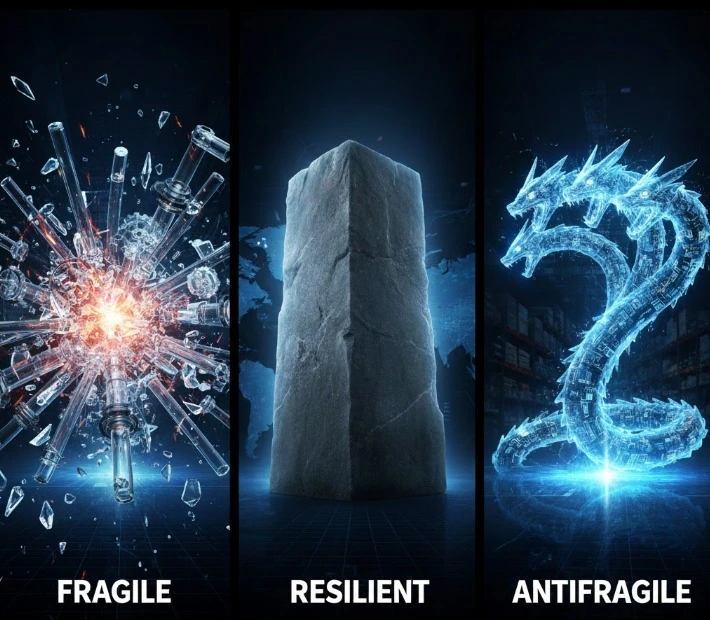
- The Fragile is like a package of thin glasses. It hates volatility. If you drop it, it breaks. In supply chain terms, this is a “hyper-lean” system with zero buffers—one strike or one late ship, and the whole line stops.
- The Resilient (or Robust) is like a stone. It can take a hit and stay the same. It resists shocks, but it doesn’t learn from them. It just survives.
- The Antifragile is like the Hydra from Greek mythology. You cut off one head, and two grow back in its place. It doesn’t just survive the attack; it becomes more formidable because of it.
In 2026, the goal of supply chain leadership is to move our operations from the “Glass” category to the “Hydra” category. We want systems that use the “stress” of a market shift to force us into better habits, faster response times, and smarter inventory positioning.
The Problem with “Bouncing Back”
Think about that resilient stone. If you drop it, it doesn’t break. That’s great, right? But it’s still just a stone. It hasn’t improved.
In the supply chain world, traditional resilience is often just exhausting. It’s a cycle of firefighting, “making it work” through sheer willpower, and absorbing massive costs just to keep the lights on. By the time the dust settles, your team is burnt out, and your margins are thinner.
We need systems that don’t just withstand chaos, but actually get better because of it.
How to Build a System That Grows Stronger Under Pressure
So, how do you actually do this? It isn’t about some magic software; it’s about changing how the “gears” of your operation move. Here are two ways I’ve seen this work in the real world:
1. Renegotiate for Agility, Not Just Compliance Most people see SLAs (Service Level Agreements) as a safety net. I see them as a throttle. In my recent work, we didn’t just ask our 3PLs to “be better.” We renegotiated those response windows to be tighter and more dynamic, specifically implementing a pre-alert system that cut our order cycle time from 24 hours down to 19.
This did two things: it forced our partners to sharpen their own operations, and it gave us a faster “nervous system.” When a disruption hits now, we don’t wait 24 hours to hear a plan; we’re already moving in five. That’s not just surviving a delay, it’s using that speed to capture market share while others are still checking their emails.
2. Tighten the Feedback Loop (Eliminate the Lag) Antifragility requires data that actually means something. This is why I’m obsessed with things like SAP Timestamping. If you have “operational lag”, meaning your data is even a few hours old, you’re flying blind. By closing that gap and parallel processing paperwork, you turn every minor delay into a lesson. Your system learns where the friction is and fixes it in real-time.
The Shift from Firefighter to Architect
The best supply chain leaders I know are tired of being the world’s best firefighters. They want to be architects.
Moving toward an antifragile model means you stop fearing the next disruption. Instead, you start looking at it as an opportunity to test your speed, refine your partnerships, and outpace your competition.
The era of reactive resilience is over. The future belongs to the supply chains that can take the heat, and use it to forge something stronger.